Dollar Weakens Against Dong on Black Market
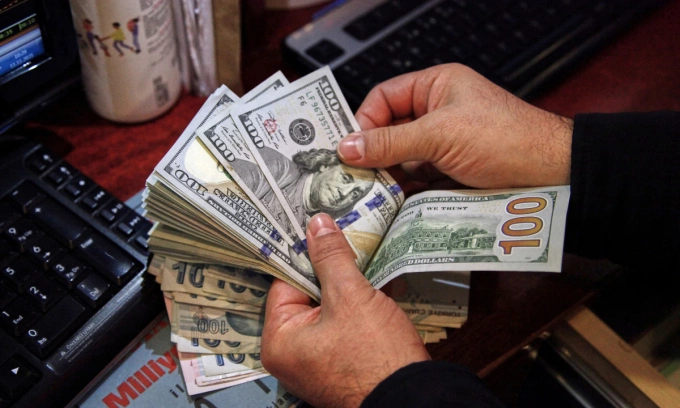
U.S. Dollar Weakens Against Vietnamese Dong on Black Market
On Monday morning, the U.S. dollar experienced a decline against the Vietnamese dong in the black market, while it remained stable against major global currencies. At unofficial exchange points, the greenback fell by 1.48% to reach VND26,550. In contrast, Vietcombank maintained its exchange rate unchanged over the weekend at VND26,476. The State Bank of Vietnam also kept its reference rate steady at VND25,216.
Globally, the U.S. dollar remained relatively stable on Monday as markets anticipated a crucial week filled with central bank decisions, particularly those from the Federal Reserve. Meanwhile, the euro showed minimal reaction to Fitch's recent downgrade of France's credit rating, which marked the country's lowest level on record.
The euro was last trading 0.09% lower against the U.S. dollar at $1.1724. Investors largely ignored the impact of Fitch's announcement, focusing instead on other economic indicators and upcoming central bank meetings. Recent expectations of a potential rate cut by the Federal Reserve have put downward pressure on the dollar, although it managed to stabilize at 97.65 against a basket of currencies on Monday.
Key Currency Movements and Market Trends
Other major currencies also showed mixed performances. The British pound remained largely unchanged at $1.3554, reflecting a cautious approach from traders ahead of significant economic events. The Australian dollar, on the other hand, reached near a 10-month high, trading at $0.6652. This movement suggests growing confidence in the Australian economy and its outlook.
The Japanese yen saw a slight strengthening, rising to 147.56 per dollar. This increase came ahead of the Bank of Japan's (BOJ) upcoming policy meeting later in the week. Traders are closely watching for any signals regarding potential changes in monetary policy, which could have wide-ranging effects on global markets.
Central Bank Decisions and Economic Outlook
As the week progresses, attention is turning toward key central bank decisions that could influence currency movements and investor sentiment. The Federal Reserve’s upcoming meeting has been a focal point for markets, with many analysts expecting a potential rate cut. Such a move could further weaken the U.S. dollar and create ripple effects across global financial systems.
In addition to the Fed, other central banks around the world are preparing to announce their policies, which could lead to increased volatility in currency markets. These decisions will be closely monitored by investors, businesses, and governments alike, as they play a critical role in shaping economic conditions and trade dynamics.
Market Reactions and Investor Sentiment
Despite the uncertainty surrounding central bank actions, some currencies have shown resilience. The euro, for example, has remained relatively stable despite the downgrade of France’s credit rating. This indicates that investors may be placing more emphasis on broader economic fundamentals rather than isolated events.
Meanwhile, the strength of the Australian dollar highlights the growing importance of emerging markets in the global financial landscape. As economies like Australia continue to perform well, their currencies may gain more traction in international markets.
Overall, the current economic environment is characterized by a mix of stability and uncertainty. While some currencies remain steady, others show signs of fluctuation, driven by a combination of macroeconomic factors, geopolitical developments, and central bank policies. As the week unfolds, market participants will be closely watching for new developments that could shape the direction of global finance.


Comments
Post a Comment