$37bn Needed Yearly to Fix Infrastructure Gap – Deputy Finance Minister
Addressing Ghana’s Infrastructure Financing Gap
Ghana is facing a significant challenge in meeting its infrastructure needs, with an estimated annual requirement of US$37 billion over the next 30 years. This demand far exceeds the country’s current fiscal capacity, highlighting a growing gap between available resources and the urgent need for development. According to the Deputy Minister of Finance, Thomas Nyarko Ampem, transport and energy alone account for more than 30 percent of this investment, underscoring the scale of the challenge.
In addition to the initial capital required, an extra US$8 billion per year is needed for maintenance. Traditional financing sources such as loans, donor funds, and domestic revenue have proven insufficient in meeting these demands. As a result, the government has turned to Public-Private Partnerships (PPPs) as a central strategy for bridging the gap and attracting sustainable investment into critical infrastructure sectors.
The Deputy Minister highlighted the potential impact of infrastructure investment on economic growth, citing the Global Infrastructure Hub supported by the World Bank. He noted that the average fiscal multiplier of infrastructure investment is 0.8 within a year and 1.5 within two to five years. Despite this promising outlook, Ghana's performance in infrastructure delivery remains underwhelming.
According to the Global Infrastructure Hub, Ghana’s infrastructure quality scores 47 on a scale of zero to 100, which is 10 percentage points lower than the average for Lower Middle-Income Countries (LMICs). Furthermore, infrastructure investment in Ghana stands at 5 percent of GDP, slightly below the 5.4 percent average for LMICs. The infrastructure financing gap in Ghana is also higher than the average for LMICs, standing at 2.8 percent of GDP compared to 1.7 percent.
Regional peers such as Kenya, Nigeria, and South Africa are performing better in terms of infrastructure investment. This under-investment has led to a critical infrastructure deficit, compounded by recent macroeconomic challenges, increased debt burdens, and limited access to international capital markets. Traditional financing mechanisms, including domestic revenue, foreign loans, and donor grants, are becoming increasingly difficult to mobilize.
These challenges coincide with demographic shifts, rapid urbanization, and rising citizen expectations. City residents demand better transport systems, industries require reliable and cheaper energy, farmers need irrigation, and young people are calling for digital highways. In response, the government is repurposing and realigning public finances to support infrastructure financing, aiming to meet the needs of both individual and corporate citizens while spurring economic transformation.
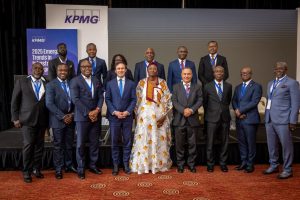
KPMG’s Roadshow, focused on unlocking the potential of PPPs, is seen as timely. It provides a platform to explore innovative infrastructure solutions and foster strategic partnerships that drive infrastructure transformation in Ghana. The government has signaled a strong commitment to PPPs, recognizing their importance in unlocking new financing, improving infrastructure quality, and harnessing private sector capital and expertise to drive economic growth.
KPMG also launched its report on Emerging Trends in Infrastructure and Transport in Ghana during the event. The Country Managing Partner of KPMG in Ghana, Andrew Akoto, announced the official launch of KPMG’s Africa infrastructure advisory practice in the country. He highlighted that KPMG has evolved into KPMG Africa, with all offices across the region working as one firm under a single governance structure.
Under the One Africa strategy, Ghana and Nigeria are assuming overall responsibilities across West Africa. This enables the firm to deliver integrated end-to-end support from policy advisory and project preparation to financial structuring, investment mobilisation, and transaction execution. Infrastructure forms a significant part of KPMG’s work under this strategy, with a commitment to working with partners and alliances to achieve the goals.
James Woodward, Africa Head of Infrastructure and Transport at KPMG, noted that Africa’s infrastructure demand is about US$170 billion annually, but only around US$59 billion is being spent on average. This leaves a deficit of roughly US$111 billion each year. He emphasized the overreliance on the public sector for infrastructure financing, with only 10 percent of ongoing projects financed by private investment.
Through stronger partnerships across governments, development finance institutions, investors, and the private sector, KPMG believes it can unlock a new era of infrastructure delivery in Ghana. By connecting global expertise with local realities, the firm aims to bridge the infrastructure financing gap and promote the participation of private capital in Ghana’s development agenda.


Comments
Post a Comment